Banda Islands vs Raja Ampat: Which Yacht Charter is Best?
Updated: May 2026
Banda Islands vs Raja Ampat: Which Yacht Charter is Best?
- Raja Ampat: The planet’s epicenter of marine biodiversity with over 1,600 fish species.
- Banda Islands: The historical “Spice Islands,” offering a blend of colonial history, pelagic encounters, and cultural depth.
- The Experience: Raja Ampat is a pure, nature-focused immersion; Banda is a multi-faceted journey through time, culture, and the sea.
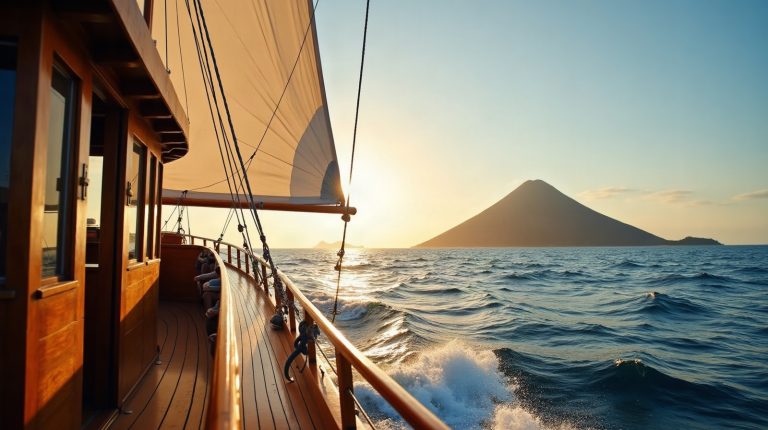
The air hangs thick and sweet with the scent of clove and drying nutmeg, a fragrant ghost of a global empire. Below deck, the gentle groan of the ironwood hull of our phinisi schooner is the only sound, a steady rhythm against the glassy sea. To port, the perfect volcanic cone of Gunung Api pierces a cobalt sky. This is the overture to the Banda Islands, an archipelago that poses a fascinating question to the discerning traveler charting a course through Indonesia’s eastern seas. The question is one of choice, a dilemma often whispered among the yachting elite: the raw, prehistoric majesty of Raja Ampat, or the layered, historical soul of Banda? As a travel editor who has spent considerable time in both, I can tell you this isn’t a choice between good and better, but between two entirely different epics written upon the water.
The Diver’s Dilemma: Biodiversity vs. Big Pelagics
Let’s begin where most of these voyages do: beneath the waves. The conversation about Indonesian diving is rightfully dominated by Raja Ampat. It is, without hyperbole, the global center of marine biodiversity. As documented by Conservation International, this region, the heart of the Coral Triangle, is home to a staggering 603 species of hard coral—that’s 75% of all known species on Earth. Famed ichthyologist Dr. Gerald R. Allen identified a record 374 species of fish on a single dive here. A charter in Raja Ampat is a full immersion into this biological kaleidoscope. At sites like Cape Kri or Melissa’s Garden, you are not just observing a reef; you are inside a living, breathing organism of unimaginable complexity. The focus is often on the sheer density and variety: pygmy seahorses, flamboyant cuttlefish, and the endemic walking shark. It is a world of vibrant, intricate detail.
The Banda Islands, however, play a different game. While its reefs are prodigiously healthy—particularly the astonishing coral gardens that have grown at warp speed on the 1988 lava flow from Gunung Api—the allure here is about scale and drama. The Banda Sea is a 7.14 million square kilometer basin, plunging to depths of over 7,000 meters. This unique bathymetry creates nutrient-rich upwellings that attract a different class of marine life. This is where you come for the grand theatre of the ocean. From September to November, the legendary schooling hammerheads arrive, sometimes in groups of 200 or more, patrolling the deep blue off the island of Run. Encounters with giant dogtooth tuna, Napoleon wrasse the size of small people, and migrating whales are the norm, not the exception. As our veteran Divemaster, Pak Yusuf, once told me, “In Raja, you use a macro lens to see the universe in a grain of sand. In Banda, you use a wide-angle lens to capture the gods of the sea.” A Banda Islands yacht charter is for the diver who appreciates that the ocean’s story is told as much in its epic pelagic migrations as in its reef-bound minutiae.
Above the Waterline: Karst Pinnacles vs. Volcanic Forts
When you surface, the distinction between these two destinations becomes even more pronounced. Raja Ampat’s landscape is the stuff of postcards, a dreamscape of limestone karst islands, sculpted by millennia of wind and water into fantastical shapes. The iconic view from Piaynemo or the more arduous climb at Wayag reveals a labyrinth of turquoise lagoons dotted with verdant, mushroom-shaped islets. It is a spectacle of pure, raw nature. The experience is primal, geological. You paddleboard through serene, silent coves where the only architecture is the handiwork of erosion. The human footprint is minimal, and the narrative is one of timeless, natural beauty. It’s a photographer’s paradise, a place to contemplate nature’s artistry on a grand scale.
Sailing into the main harbor of Banda Neira offers a starkly different, yet equally compelling, visual. The landscape is dominated by the imposing, symmetrical cone of the Gunung Api volcano, a constant, watchful presence. But the eye is quickly drawn to the man-made structures that tell a story of global power and conflict. Perched above the town is Fort Belgica, a pentagonal fortress built by the Dutch in 1611, its restored walls a testament to the immense value of the prize it was built to protect: nutmeg. Across the channel on Banda Besar, the ruins of Fort Nassau lie shrouded in vegetation. The entire town of Banda Neira is a living museum of Dutch colonial architecture, with grand mansions and crumbling warehouses lining the waterfront. As noted on its UNESCO World Heritage tentative list submission, the Banda Islands represent an “unprecedented example of colonial town planning.” Here, the scenery is not just a backdrop; it is a historical document, a landscape where every stone has a story to tell about the birth of globalization.
A Tale of Two Histories: Prehistoric Majesty vs. The Spice Trade Epic
The soul of a place is found in its stories. Raja Ampat’s story is ancient, written in the rock art of its caves and the oral traditions of its Papuan communities. It is a narrative of deep connection to the sea, of Austronesian navigators and a way of life that has existed in harmony with this marine eden for centuries. The history here is natural history; the key events are not battles or treaties, but the shifting of tectonic plates and the evolution of species. A journey through Raja Ampat feels like a step back into a prehistoric world, a visit to a planet still in its purest form. The experience is humbling, a reminder of a world that existed long before our modern anxieties.
The history of the Banda Islands, by contrast, is a dramatic, human, and often brutal epic that altered the course of world history. For centuries, these ten tiny volcanic islands were the only place on Earth where nutmeg and mace grew. In the 17th century, these spices were worth more than their weight in gold in Europe, and the Dutch East India Company (VOC) was willing to do anything to control the source. The 1621 conquest of the islands was a bloody affair, and the subsequent Dutch monopoly on the nutmeg trade funded the Dutch Golden Age. On a luxury voyage on the Spice Route, this history is not confined to a museum. You walk the battlements of Fort Belgica, visit the still-producing nutmeg plantations where the scent of the spice is intoxicating, and stand in the house where the last English governor signed the treaty that, in 1667, traded the island of Run for a swampy trading post in North America called Manhattan. To sail here is to sail through the very crucible of global capitalism.
Logistics and Exclusivity: The Practicalities of a Charter
From a purely practical standpoint, the two destinations present different considerations. Raja Ampat is the more established of the two for high-end tourism. The gateway airport in Sorong (SOQ) is relatively well-serviced, and a larger fleet of charter yachts and liveaboards operate in the region. This provides more choice in terms of vessels and itineraries. The main season runs from October to April, coinciding with the dry season. While marine parks have regulations, the popularity of key sites can sometimes mean sharing a pristine anchorage or dive site with another vessel. It is magnificently remote by global standards, but less so within the context of eastern Indonesia.
The Banda Islands occupy a different sphere of remoteness. The primary entry point is Ambon (AMQ), and significantly fewer yachts are based here or make the multi-day crossing to include it on their seasonal calendar. This is the paramount appeal for many. On our last ten-day charter, we encountered only one other private vessel. This sense of profound isolation, of having an entire archipelago to yourself, is a luxury that cannot be overstated. The seasons are also more defined and split, dictated by the monsoons. The best windows for a calm sea crossing and clear waters are March to April and again from September to November. This logistical challenge filters out the masses, ensuring that a banda islands yacht voyage remains an exercise in genuine, undiluted exploration. The experience is one of true discovery, far from any established tourist trail.
Quick FAQ: Banda Islands vs Raja Ampat Yacht
Which destination is better for non-divers?
Unquestionably, the Banda Islands. While Raja Ampat has beautiful beaches and kayaking, its primary draw is underwater. The Banda Islands offer a far richer above-the-water experience with their deep history, colonial architecture, spice plantations, local culture, and volcano hiking. It’s a complete destination for the intellectually curious traveler.
When are the best seasons to charter a yacht?
They have opposite seasons. Raja Ampat’s prime time is during the northwest monsoon, from October to April, when the seas are calmest. The Banda Islands are best visited during the transitional periods between monsoons: March-April and September-November.
Is one more exclusive than the other?
Yes, the Banda Islands are significantly more exclusive. Due to their remote location and the smaller number of yachts that service the area, you are guaranteed a more private and intimate experience. It’s common to go for days without seeing another charter vessel.
What about the cost of a banda islands vs raja ampat yacht charter?
The base charter rates for a comparable luxury phinisi are often similar. However, a Banda Islands charter may incur higher total costs due to repositioning fees for the yacht, as most are based in Labuan Bajo or Sorong. The premium, however, buys a level of exclusivity that many find invaluable. You can learn more about travel in the region from official sources like Indonesia Travel.
Ultimately, the chart you plot depends on the journey you seek. Raja Ampat is a peerless sanctuary of natural wonder, a destination for the diving connoisseur whose primary goal is to witness the zenith of marine life. It is a physical and visual immersion. The Banda Islands, however, offer this and so much more. They offer a fourth dimension to travel: time. It is a destination that engages the mind as much as the senses, a place where a morning dive with hammerhead sharks can be followed by an afternoon walking through the pages of a history book that shaped the modern world. The choice is not about which is better, but which story you wish to inhabit. If your spirit seeks a narrative woven from the threads of empire, spice, and the grand, lonely theatre of the open ocean, then your compass is already set. Explore the possibilities of your own banda islands yacht expedition with us.